How to Card Wool with a Drum Carder, Step by Step
By the end of this guide, you’ll have a batt ready to spin. Clean, teased wool goes in lengthwise, a steady clockwise crank carries it onto the big drum, and you lift the finished batt off at the seam. Where the makers’ instructions differ, the difference is below.
What you need
- A drum carder, clamped to a table or bench. Ashford’s Wild Carder instructions say to clamp it down before you start. Strauch’s Petite manual says to use only the clamp supplied, not a C-clamp, which it says can damage the frame.
- Washed wool. Strauch’s hints sheet opens with “Card only washed, clean fiber.” The lanolin makes it hard to card and leaves residue on the drums.
- The tools that come with the carder: a doffer (Ashford calls it an awl) or batt picker, and a cleaning brush.
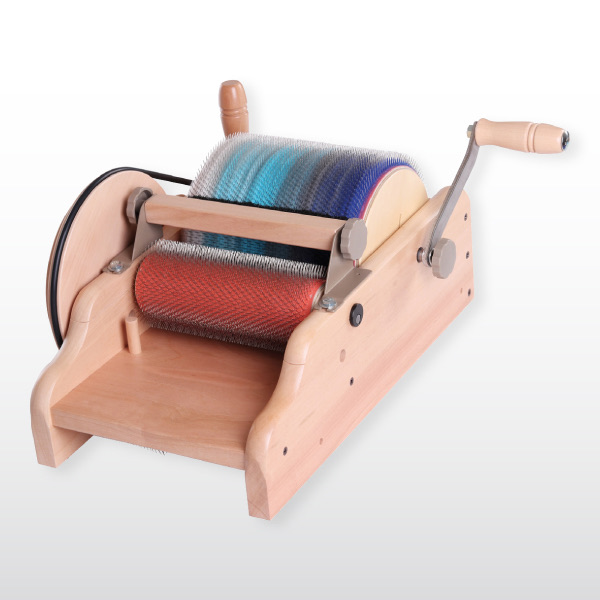
Four carders to look at: the Ashford Drum Carder (9 in), the Ashford Wild Drum Carder, the Strauch Petite and the Louet Junior Drum Carder.
How to use a drum carder: the steps
1. Tease the wool
Tease the fiber before it goes in, pulling clumps apart or discarding any too tight to separate. Strauch warns that large, tangled clumps can damage the machine.
Ashford adds: tease the staple tips with a flick carder, pull each staple apart sideways, and card small amounts at a time. Peel sliver into strips and spread it out sideways.
2. Feed the fiber
Turn the handle clockwise. Feed the teased fiber lengthwise, a little at a time, and fill the drum evenly across its width.
Don’t grip the fiber. Ashford’s Wild Carder sheet says: “Allow the fibres to feed-in, don’t hold them back with your hand.” Strauch gives the reason: hold it too tightly and it winds around the small drum instead of moving to the large one.
Keep fiber away from the drum ends. Strauch’s cleaning sheet says to stay about 3/4 inch in from the ends of the small infeed drum, so fiber doesn’t spread off the large drum onto the shafts and drive. Ashford makes a similar point about keeping fiber between the guide pegs on the feed-in tray.
3. Set your drum speed
There are two things to get right: how fast you crank and, on Ashford’s drum carders, which ratio you use.
- Cranking: the Strauch Petite manual says best results come from “a steady, smooth (not fast) cranking motion.” Ashford’s Wild Carder booklet likewise says to wind the handle clockwise, not too fast.
- Ratio: Ashford’s drum carder manual gives two ratios, 6:1 and 4:1.
| What you’re making | Ashford ratio |
|---|---|
| Preparing a fleece, for a smooth even batt | 6:1 |
| Blending sliver, colors and fiber types, for an open, airy batt | 4:1 |
The Louet Junior is different: Louet gives a 4:1 acceleration and a 9:1 surface-speed ratio.
4. Know when the drum is full
Keep going until the drum accepts no more. Both makers describe the sign: fiber starts collecting on the small drum. Ashford says to stop and remove the batt at that point. Strauch says that with the brush attachment, you can stop feeding and keep cranking until the fiber transfers across to the large drum.
5. Doff the batt
Ashford’s Wild Carder booklet gives the order:
- Turn the handle until the metal strip (doffer strip) is at the top of the drum.
- Loosen the knob and twist the packer brush up and away.
- Slide the pointed end of the doffer along the strip and lift to separate the fiber, working in short sections across the width.
- Pull the batt back and down over the end of the carder while slowly turning the handle the opposite way.
Strauch’s batt picker works the same way: insert the point along the seam under the fiber, lift and separate in sections, then roll the batt off while slowly turning the drum backward.
6. A second pass, if the fiber allows
Strauch says you may want to re-card a batt for more thorough blending. For very fine fibers such as merino, it says the opposite: carding makes neps, so one pass is recommended, and the locks should be fed cut end first, one at a time.
For slippery mohair or angora, Strauch suggests laying the fiber between two thin layers of wool and pressing down with your palm as it feeds.
Keeping it clean
From Strauch’s cleaning sheet:
- Clean the large drum with the doffer brush. Start at the seam and brush in the direction the teeth point, rotating the drum backward slowly. The sheet says “Use the same force as you would in currying a horse or dog.”
- Never brush side to side across the drum. Strauch says this will damage the teeth on both the drum and the brush.
- You don’t need to clean after every batt. You can leave the leftover fiber on the drum between batts of the same fiber, and clean when you finish or switch to a different color or fiber.
- A small brush clears shorts and neps from the infeed drum. Tweezers, an old toothbrush or a thin-nozzle vacuum remove fiber from the shafts.
Ashford and Strauch both say to take the drive band off when you put the carder away, so it doesn’t stretch.
Common first problems
- Fiber wraps the small drum. You’re holding the fiber too tightly, says Strauch. Let it feed freely.
- Fiber piles up on the small drum. The large drum is probably full. Remove the batt (Ashford), or keep cranking until it transfers (Strauch with the brush attachment).
- Greasy or clogged teeth. Strauch says unwashed wool causes this. Wash first.
- The handle is getting hard to turn. Strauch’s Petite manual says to clear built-up fiber from each shaft where it enters the bearings.
- Teeth too far apart or touching. Ashford’s Wild Carder instructions give a factory gap of 0 to 1 mm, and its drum carder manual marks 1/16 in. Strauch says the teeth should come just short of touching.
Your first 3 projects
- Batts for spinning. Ashford describes the batts as ready for spinning or felting. Louet says batts from the Junior come out around 40 g.
- A blended batt. Ashford’s drum carder manual gives a 4:1 ratio for blending.
- Rolags from a batt. Strauch’s cleaning sheet points to a short video on locking the brush attachment to make rolags, on YouTube.
Made one of these? We’d love to see it.
See it done
Spinners and makers on YouTube.
- Blending A Sparkly Rainbow Batt On My Drum Carder, from JillianEve
- Blending Board vs Drum Carder: which one do you choose?, from SweetGeorgia
- Bam Fiber Works drum carder with the self cleaning roller, from Camaj Fiber Arts. This is a different brand of carder, so the controls may differ.
FAQ
Do I need to wash wool before carding? Yes. Strauch says to card only washed fiber, because lanolin makes carding hard and can damage the card cloth teeth. Ashford says unwashed wool’s dirt and grease reduce the life of the carder.
How much wool makes one batt? It depends on the carder. Ashford’s Wild Carder instructions say to prepare 40 g (1.5 oz) batts, and Louet gives about 40 g for the Junior.
Can I card merino? Strauch says to take care with very fine fibers like merino: prepare the locks well and make only one pass, since carding creates neps.
Do I clean the drum between batts? Not necessarily. Strauch says you can leave the leftover fiber between batts and clean when you finish or change fiber.