Why People Love Fiber Crafts, in Their Own Words
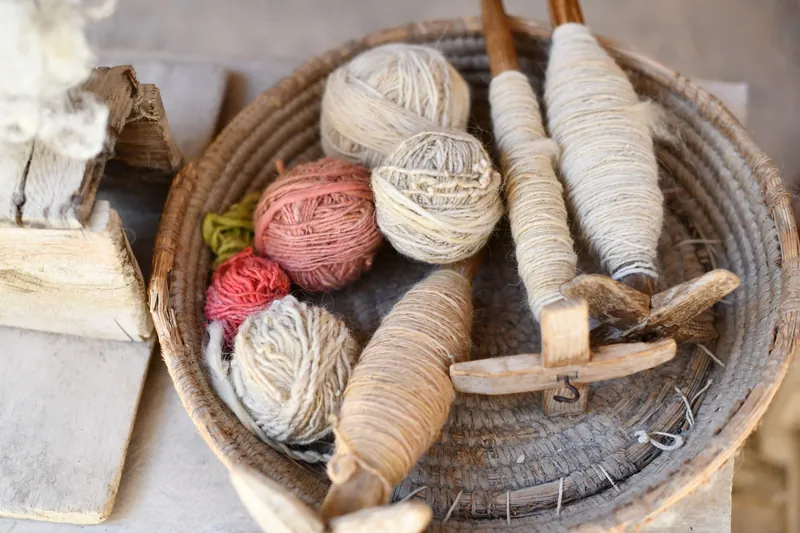
Ask spinners and weavers what they get from their craft and the same few answers keep coming up in the accounts below: a slower pace, calm, something to make for and with the people they love, company, and the satisfaction of making something yourself. Fiber crafts here means the work of turning fiber into something: spinning it into yarn, weaving yarn into cloth.
Slowness
Several of these makers name the slow pace as part of the appeal.
“I find spinning to be grounding, especially when the world is moving very quickly,” says Janelle on the Sheepspot podcast. She sees spinning by hand as a way to push back against a frenzied pace. On the same episode, Sherry Zapadka describes a job where she is never caught up, and says her craft lets her picture a slower way of living.
Weavers say it too. The loom maker Mirrix published entries from its “Why I Weave” contest, and Lena K. calls weaving “a slow process that forces me to be focused and thoughtful.” Molly E. writes of its slow pleasures for the hands.
Sarazen AnYin, a master handspinner, finds perspective in it. Spinning is slow enough, she points out, that her kids would be short of clothes if she had to make them all this way.
Calm
Close to slowness is quiet. Lexi LaMar, who grew up raising sheep, keeps spinning at college as “a nice stress-relieving, calming hobby.” On Sheepspot, Mary Homan loves to feel fiber between her fingers and calls preparing it meditative, and she says spinning and knitting help keep her balanced. Wikipedia’s article on hand spinning lists meditative qualities among the reasons people take it up.
In Mirrix’s entries, Carrie B. weaves to settle a busy mind, and Kate S. credits weaving with helping her build resilience. Daniela C. describes weaving as a gentle pastime she can leave and come back to.
Making for family, and with them
Lori Remz, president of the Spokane Handweavers’ Guild, recalls her childhood potholder loom and the potholders she gave everyone at the holidays.
Sometimes the family joins in. Sarazen AnYin remembers spinning with “my toddlers putting their small hands on mine.”
Sometimes family is why the craft carries on. Pam A., in the Mirrix entries, weaves to honor the generations before her. Terrie K. writes of the beads her grandmother gave her. The Diné weaver D.Y. Begay says, “My family has raised sheep for many generations,” and her sister keeps that work going. Nilda Callañaupa Alvarez learned as a child in Peru, and a Textile Museum of Canada page on her natural dyeing work looks to the day elders pass their wisdom on to local children.
Belonging
The work itself can be quiet and alone, so people go looking for each other. “Weaving is a solitary activity – this is a way to meet other people,” says Ellen Peller, who joined the Spokane guild by Zoom during lockdown and then came to its monthly meetings.
On Sheepspot, Nancy Richard says daily spinning connects her both with herself and with a larger community, and Marcy George finds company with like-minded people inspiring. Sarazen AnYin says she has met wonderful people in her spinning group. Stephanie H., in the Mirrix entries, feels connected to a community when she weaves.
Guilds give that belonging a place and a time. The Tawe Guild says, “We meet weekly to pursue our crafts and monthly to learn new skills.” Triangle Weavers has a fiber arts center where lovers of fiber arts “gather to learn, share and socialize.”
Making something that is yours
Some of it is plain satisfaction. Sandy Staff-Koetter, a longtime Spokane member, calls it magic to watch threads turn into fabric. Sarazen AnYin values being able to make yarns no shop sells.
It also comes with honest frustration. Staff-Koetter admits a mistake can be discouraging. Remz says weaving is neither quick nor easy. Kromski’s drop spindle manual says spindling takes practice, and asks you not to get discouraged. Ashford’s spinning booklet has a kinder word for first attempts: “Uneven yarn is OK.”
FAQ
Do I have to join a guild?
No. Ellen Peller began with online classes and a simple loom at home. A guild is one way to find company, and the Tawe Guild says anyone with an interest is welcome to visit first.
Your next step
If something here sounds like what you want, meet the people who take this up, then see what each craft involves in start here, or choose one with spinning or weaving: where to start.
Further reading
- Spin Off: 13 Reasons to Join a Spinning Guild
- Spin Off: What Do You Love About Your E-Spinner?
- Mirrix: Select Entries from the Why I Weave Contest