Start Here: What Spinning and Weaving Are, and How to Begin
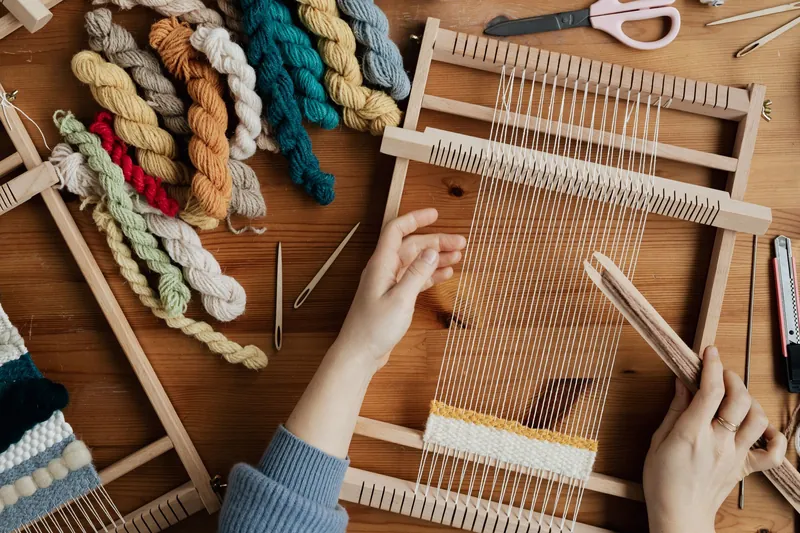
Spinning turns loose fiber, such as wool, into yarn. Weaving turns yarn into cloth. Either one can be your first craft.
To spin, you draw a few fibers out of a handful of wool and twist them. The twist holds the fibers together as a thread, and the thread keeps growing for as long as you keep drawing out and twisting. People do this three ways, and all three make the same thing:
- A spindle, a weighted stick you set turning by hand.
- A spinning wheel, where a foot pedal keeps the turning going and leaves both hands free for the fiber.
- An e-spinner, a small electric spinner whose motor does the turning.
What is spinning takes you through it from fleece to finished yarn.
To weave, you stretch a set of threads tight on a loom, the frame or device that holds them. These lengthwise threads are called the warp. A second thread, the weft, goes over and under the warp, one row after another, and the rows build up into cloth. What is weaving, and what is a loom covers each kind of loom and what it makes.
How the two fit together
Yarn is what weaving uses, but neither craft depends on the other. Ashford’s first weaving project is a scarf woven from bought yarn. Handspun yarn, in turn, can go on to knitting, weaving and fiber art. You can do both, and you can start with whichever one draws you.
What people make
Spinning ends in a skein, a coil of finished yarn. Ashford’s first lesson takes you to a two-ply skein. You spin two strands, called singles, then twist them together for a strong, balanced yarn. That twisting together is plying.
Weaving can start with a scarf. Ashford’s first project is a striped scarf from a 2 m (79 in) warp, finishing 28 cm (11 in) wide. Kromski’s Presto scarf sheet plans one of 15 x 150 cm (6 x 60 in). From there, a loom can make shawls and dish towels.
Different looms make different things. An inkle loom is a wooden frame with pegs to hold the warp, and Kelly Casanova writes, “An inkle loom is for weaving bands,” which are narrow strips of cloth. Frame looms make tapestry-style, weft-faced pieces, where the weft thread covers the warp.
Which to begin with
Start with what you want to make.
| You want | Begin with | Then read |
|---|---|---|
| Your own yarn | Spinning, on a spindle, a wheel or an e-spinner | How to start spinning yarn |
| A length of cloth, such as a scarf | Weaving, on a rigid heddle loom | How to start weaving |
| Not sure yet | The side-by-side guide | Spinning or weaving: where to start |
Both Ashford and Kromski use a rigid heddle loom for their beginner scarf projects. One slotted and holed piece, the reed, lifts half the warp threads at a time to open a gap for the weft. The whole loom sits on a tabletop or a stand. Teacher Kelly Casanova advises the same for anyone completely new to weaving, and calls it “lightweight enough to carry from room to room.”
What you need
Room. Spinning needs a chair and space to lean back from the wheel, so your hands can work. Ashford’s lesson tells you not to sit too close. A wheel stands on the floor, and an e-spinner is smaller.
Weaving starts with a long table or two smaller ones, because a 2 m (79 in) warp has to be stretched out when you put it on the loom. After that, a rigid heddle loom needs a tabletop. Floor looms need floor space and are heavy.
| Tool | Size | Weight |
|---|---|---|
| Wheel: SpinOlution Pollywog | 15 in wide, 9 in deep, 20.75 in high | 8.5 lb |
| Wheel: Ashford Kiwi 3 | 5.5 kg | |
| E-spinner: Ashford e-Spinner 3 | 26 x 14 x 21.5 cm (10¼ x 5½ x 8½ in) | 2 kg (4.4 lb) |
| Floor loom: Schacht Baby Wolf | 60 to 73 lb, depending on the number of shafts, the frames that lift the warp threads |
What it costs.
| Tool | Price, 31 Oct 2026 |
|---|---|
| E-spinner: EEW Nano 2.1 | $139 list |
| Spinning wheels, 10 with a maker’s list price: Louet S17 single treadle kit to SpinOlution Monarch | $417.38 to $1,445 list |
| Spinning wheels, new at The Woolery (22 listed): unfinished Ashford Kiwi 3 to Majacraft Aura | $629 to $2,179.99 at The Woolery |
| Rigid heddle looms: Schacht Cricket and Flip, smallest size | From $241 and $387 list |
| Floor loom: Schacht Baby Wolf | From $2,386 list |
That’s the tool alone. Fiber and yarn are bought separately, and a dealer can quote any wheel or loom.
Learning it. Ashford’s spinning lesson begins before you touch any wool. You practice working the pedal alone, then spin plain yarn, and only then move to wool. Its hint for your first yarn: “Uneven yarn is OK.”
Kromski’s spindle manual recommends that a beginner seek help from a fellow spindler or online. Local guilds, the clubs where spinners and weavers meet, are another place to try it first. The Susquehanna Valley guild lets you attend one meeting free, and Triangle Weavers opens its meetings to the public.
Where to go next
What the tools are
- What is a spinning wheel
- What is an e-spinner
- What are fiber prep tools
- Spinning and weaving words, a glossary for any word that trips you up
Start making
- How to start spinning yarn
- How to start weaving, then how to warp a rigid heddle loom
- How to card wool with a drum carder, once you want to prepare your own fiber
Choose your gear
- Spinning wheels, e-spinners, looms and fiber prep tools, each side by side
The people
FAQ
Do I have to choose one craft?
No. The Handweavers Guild of America brings weavers and spinners together, and handspun yarn can go into weaving.
Do I need to buy anything before I read further?
No. Read the explainers above first. The wheel, e-spinner or loom you want depends on what you want to make.
Where do I find people to learn with?
The Handweavers Guild of America keeps a directory of affiliate guilds. When you have made something, share your project.
Further reading
- Hand spinning and Loom, Wikipedia
- Learn to Spin and Learn to Weave on the Rigid Heddle Loom, Ashford
- Drop spindle kit manual and Presto scarf, Kromski
- Understanding loom types, Schacht