What Is a Spinning Wheel? Parts, Uses and Types, Explained
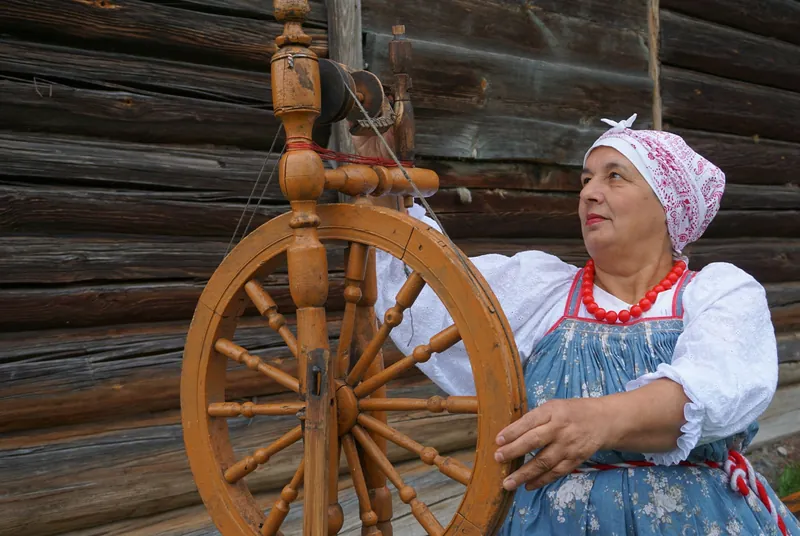
A spinning wheel is a machine that twists fiber into yarn. A foot pedal keeps it turning, so both of your hands stay free to feed in the fiber. Before the wheel, spinners twisted by hand with a spindle, a weighted stick. The wheel does the same twisting faster, and it winds the finished yarn onto a spool as it goes. If you are new to the whole craft, what is spinning explains the steps from fleece to yarn first.
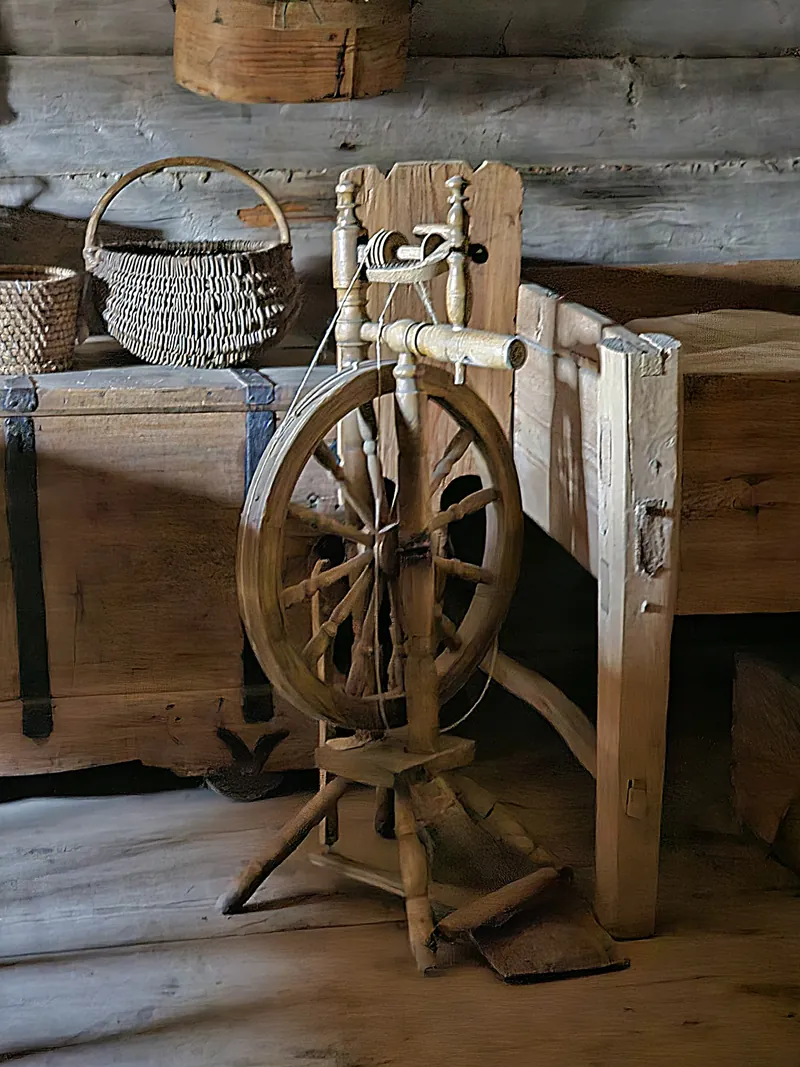
How a spinning wheel works
Start with the job. Spinning means drawing a few fibers out of a handful of wool and twisting them so they hold together as a thread. The wheel supplies the twist, and your hands supply the fiber.
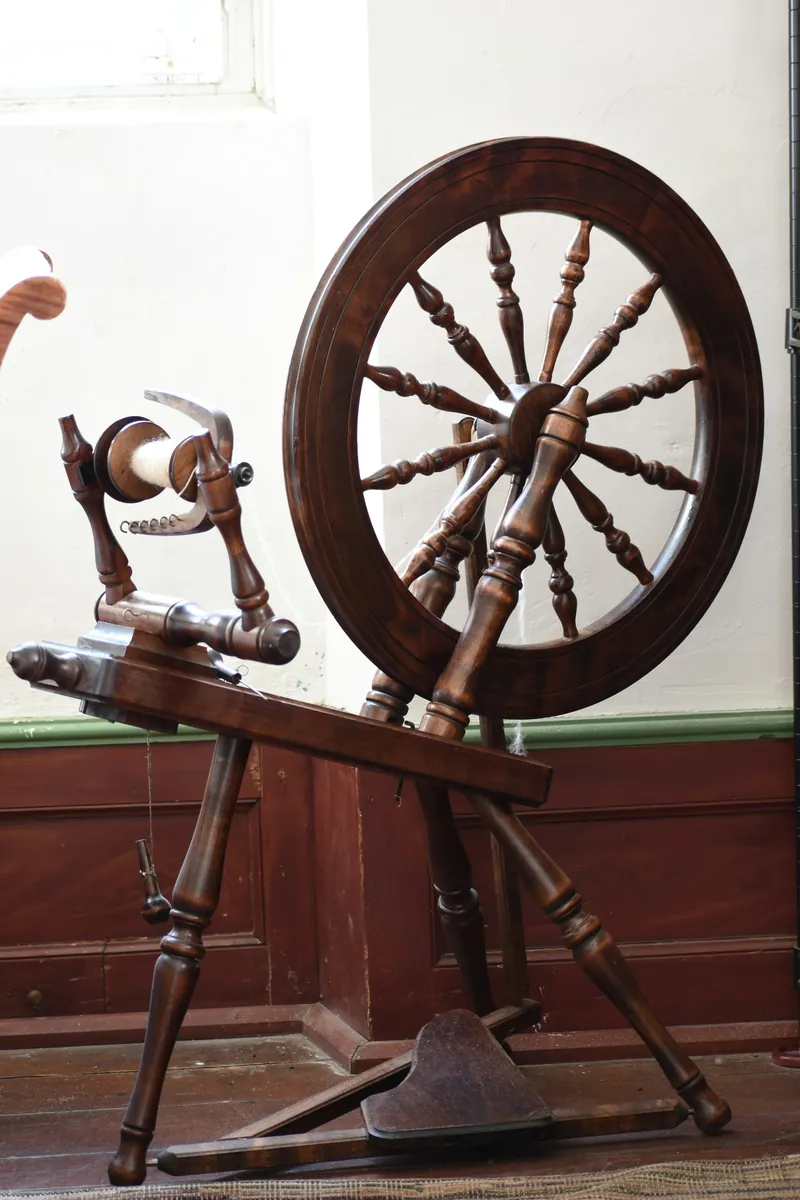
Here is how the turning reaches the fiber. You sit in a chair with your feet on the treadle, the foot pedal. Pressing it turns the drive wheel, the large wheel. A cord called the drive band runs from that wheel to the flyer, a U-shaped piece that twists the yarn. The yarn passes through the orifice, a small opening at the flyer’s end, then runs along the flyer’s arms and winds onto the bobbin, the spool.
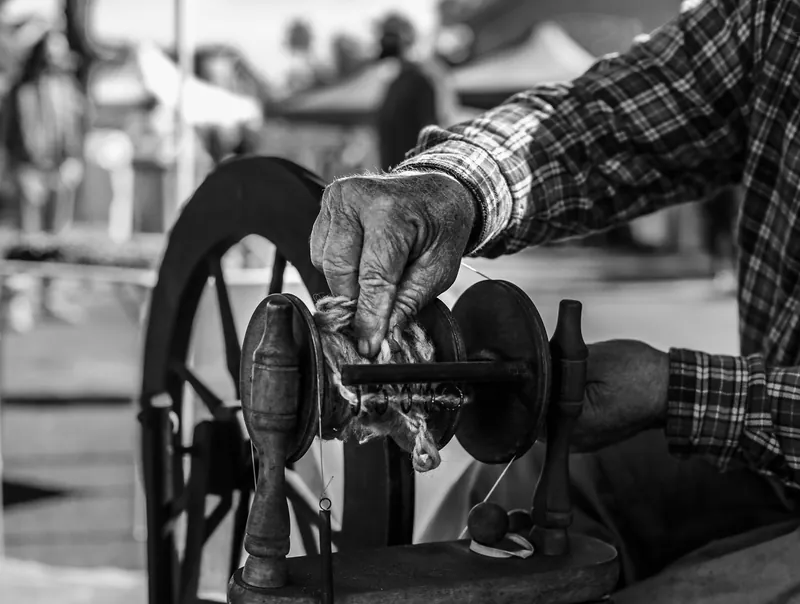
Winding on works because the bobbin and the flyer turn at slightly different speeds. If they turned together, the yarn would only twist and never wind. A tension system, covered below, is what keeps the two speeds apart.
Your hands do the rest, and each has its own job. The front hand pinches the yarn, which stops the twist running back into the loose fiber. The back hand holds the fiber lightly and lets it draw out. Drafting is the name for that drawing out: you pull fibers so that only a certain amount takes the twist. Then you relax the pinch, slide your fingers back, and the twist follows. How to start spinning yarn walks through it step by step.
The parts, in plain words
| Part | What it is | What it does |
|---|---|---|
| Treadle | The foot pedal | Turns the drive wheel |
| Drive wheel | The large wheel | Carries the turning to the drive band |
| Drive band | A cord | Carries the power from the wheel to the flyer or bobbin |
| Whorl | A grooved pulley on the flyer or bobbin | Holds the drive band; which groove it sits in sets the speed |
| Flyer | The U-shaped piece | Twists the yarn and carries it to the bobbin |
| Orifice | The opening the yarn passes through | Guides the yarn from your hands into the flyer |
| Bobbin | The spool | Holds the spun yarn |
| Brake band | A band over the bobbin’s whorl | Slows the bobbin slightly, so the yarn draws in and winds on |
| Maidens | Two upright posts | Hold the flyer and bobbin in place |
| Mother-of-all | Usually the whole spinning assembly | The maidens, flyer and bobbin together |
| Lazy kate | A holder for bobbins | Keeps full bobbins steady while you ply |
| Leader | A length of yarn tied to the bobbin | Gives your new fiber something to join onto |
Plying is twisting two or more strands of spun yarn together, in the opposite direction to the spinning. That is the job of the lazy kate: two full bobbins sit on it while the strands feed onto an empty bobbin on the flyer.
On a wheel with more than one speed, a ratio is the number of times the flyer turns for each turn of the drive wheel. A higher ratio puts more twist into the yarn for each push of the pedal. A fine yarn needs more twist than a thick one to be strong, so higher ratios lean toward finer yarn.
You change the ratio by moving the drive band to another groove on the whorl, and a smaller groove gives a faster ratio. Ashford’s Kiwi 3 offers 5.5, 7.5 and 9.5, and its Joy 2 offers 6, 8, 11 and 14.
Why use a wheel instead of a spindle
A spindle is a stick with a weight, called a whorl, that you set turning by hand. (On a wheel, the whorl is the pulley instead.) You draft a little, let the twist run up, and when the spindle reaches the floor you wind the yarn onto its shaft and start again.
The wheel removes the stopping and winding. The treadle keeps the turning going, and the bobbin collects the yarn as you spin, so one session makes more yarn, and quicker, than a spindle does. Kathy McCune, in a WoolMaven article, adds that a wheel will last a lifetime. A spindle is portable and needs only your hands, and a wheel is the larger purchase.
Do you need a wheel to start?
No. Ashford and Kromski both publish drop spindle instructions for beginners.
Writers differ here. Mother Earth News, introducing excerpts from Bette Hochberg’s Handspinner’s Handbook in 1977, said a handspindle will do for starters. McCune favors starting on a wheel, for the motivation it gives a new spinner.
If a wheel is what draws you, Ashford’s beginner booklet is written for one. A third route is an e-spinner, which swaps the treadle for a motor.
One treadle or two
Some wheels have one treadle, worked by one foot, and some have two, one for each foot. Sometimes one model comes both ways. Ashford’s Joy 2 comes as a single-treadle wheel at 5 kg and a double-treadle wheel at 5.1 kg, and Louet added a double-treadle version of its S17 in 2024.
Textile Indie’s buying guide sets out the trade-offs:
- Single treadle: usually cheaper and simpler, and can be easier for beginners to coordinate. It may tire one leg or use it unevenly.
- Double treadle: more balanced and steadier, and can be easier to maintain speed on. It costs more, and may have a steeper learning curve for some beginners.
SpinOlution’s user guide notes that on its lowest ratios treadling takes very little effort, and some spinners keep the wheel going with one foot on one treadle. Neither is a settled rule, so the choice can follow your budget and how you like to work.
Tension systems
- Scotch tension (single drive): one drive band turns the flyer, and a separate brake band rubs on the bobbin so the yarn winds on. Ashford’s Kiwi 3 and Joy 2 work this way.
- Double drive: one band loops twice, around the flyer’s whorl and the bobbin’s whorl. The two whorls are different sizes, so they turn at different speeds and no brake band is needed. Ashford’s Traditional wheel comes in double drive and single drive and can be converted from one to the other.
- Irish tension: the drive band turns the bobbin, and the brake sits on the flyer instead. Louet’s S17 is an Irish tension wheel.
What a wheel costs
| Wheel | Price, 31 Oct 2026 |
|---|---|
| Louet S17 single-treadle kit, unfinished birch plywood | $417.38 list |
| SpinOlution Pollywog, complete with three bobbins | $495 list |
| Ashford Kiwi 3, unfinished | $629 at The Woolery |
| Ashford Kiwi 3, finished | $799 at The Woolery |
| SpinOlution Monarch | $1,445 list |
| Majacraft Aura | $2,179.99 at The Woolery |
“Unfinished” means the wood arrives bare, and Louet recommends finishing its S17 kit before use. The Woolery listed 22 new wheels that day, running from the unfinished Kiwi 3 to the Aura. A dealer can quote any wheel.
Four wheels side by side
| Wheel | Treadles | Tension | Ratios | Weight |
|---|---|---|---|---|
| Ashford Kiwi 3 | 2 | Scotch | 5.5, 7.5, 9.5 | 5.5 kg |
| Ashford Joy 2, single treadle | 1 | Scotch | 6, 8, 11, 14 | 5 kg |
| Ashford Joy 2, double treadle | 2 | Scotch | 6, 8, 11, 14 | 5.1 kg |
| Louet S17 | 1 or 2 | Irish | 5.5, 7.5, 10.5 | 5 kg |
Where to go next
- First steps: how to start spinning yarn.
- Your fiber: wool sold as sliver, a ready-to-spin strip, needs no preparing. For fleece, see what are fiber prep tools.
- Comparing wheels: find your wheel, starting from what you want to make.
- New words: the spinning and weaving glossary.
- The whole craft: start here.
FAQ
How does a spinning wheel work?
Your foot works a treadle, which turns a large wheel. A drive band carries that turning to the flyer, which twists the fiber into yarn and winds it onto the bobbin. Your hands draft the fiber.
Is a spinning wheel better than a spindle?
A wheel makes more yarn, faster, and keeps both hands free. A spindle is portable and needs only your hands. Teachers differ on which to start with.
Do I need two treadles?
No. Both are made. Textile Indie’s guide finds single usually simpler and cheaper, and double more balanced.
What does a ratio mean?
It is the number of flyer turns for each wheel turn. A higher ratio adds more twist per treadle push, which suits finer yarn.
Further reading
- Spinning wheel, Wikipedia, and the glossary, Joy of Handspinning
- Learn to Spin and the student drop spindle sheet, Ashford
- Drop spindle kit manual, Kromski
- SpinOlution user guide
- How to choose your first spinning wheel, Textile Indie
- Should you learn to spin on a wheel or a spindle?, WoolMaven
- Learning How to Spin Yarn: Spindle vs Wheel, Spin Off